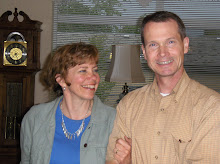
Lucy's family beading in her living room/workshop/display room.
  Lucy teaching Paul to roll a paper bead.
Last Saturday when we went to Lucy's home to pick up my gomesi we stayed and visited for awhile. Paul got to meet Lucy's husband, Nelson, and their extended family. Lucy and Nelson have five children of their own and about another five children of relatives who live with them. Everyone helps support the family by making paper bead necklaces. I was surprised and pleased to learn that Lucy had learned bead making from Bead for Life, the organization I volunteer for. She has since gone to her home village and taught the women to bead. Now they send her the necklaces they make, as well as other handicrafts, and she sells them from her home and at craft markets to help the women support their families. Someone has also set up a web site for her. You can take a look if you want at womenwithhope.jimdo.com. Unfortunately, I can't guarantee that if you were to buy from her you would get what you ordered. International shipping is difficult for an individual to guarantee, though she tells me she has managed it successfully.
Lucy personifies for me much of what is good and what is distressing about Ugandan life. Her husband is the pastor of a small independent church and they live on almost nothing. Her living room has one broken down wicker settee which is covered with a tattered piece of foam, and a couple plastic lawn chairs. Her bedroom, the other room in the house, has a bed. There are nails in the wall from which they hang their clothes. The only item of value I saw was a small tv. (Nelson said they watch CNN and wanted to know why, since the U.S. has a two-party political system, there was a Tea Party as well.) There are several other small concrete buildings on their compound, where I assume the children sleep. Although they have so little, they are obviously the well-to-do among their family because they are supporting these other children. Not only that, they're reaching out to help their villagers with the beading project and with a school which they are starting. So far they've only been able to pay for teachers for the first couple primary grades. There are no books or any other supplies. There may not even be a building.
The distressing part of this is that we, as Westerners, are looked upon automatically as patrons. Ugandans believe in indirect communication, so they don't come right out and ask, but they hint broadly that you could help them. Their need for school fees for the children quickly comes up. Lucy took me into her bedroom, took my hands in hers, looked directly into my eyes and said, "See how I live. I want you to be able to testify to people that, even though I am a pastor's wife, this is all I have." The implication is clear and compelling: if we chose to we could ease their suffering. The problem we face with that is twofold. Yes, we could help them, but their neighbor's need is equally compelling, as is the need of each villager in Ngenge where Paul works, and the need of our househelper's sister, who ran away from her husband who beat her. The needs are overwhelming and immediate. The second problem, and I'm not going to mince words here, is that many Ugandans will lie to you to get your money. Lucy seems honest and from the asking around I've done her story holds up, but you never know. So many well-intentioned Westerners have been ripped off by falling for sad stories. What a shame. Honest people will go wanting because dishonest people ruin trust. It's a story as old as time and as widespread as the whole world.
In this situation, we actually have a fairly easy path forward. Lucy is doing sewing for us and we will buy a generous amount of crafts from her to bring home. By not just giving money, but by supporting her work, we feel that we can legitimately help her. It won't be all she hopes for, but it will be a step forward.
Lucy personifies for me much of what is good and what is distressing about Ugandan life. Her husband is the pastor of a small independent church and they live on almost nothing. Her living room has one broken down wicker settee which is covered with a tattered piece of foam, and a couple plastic lawn chairs. Her bedroom, the other room in the house, has a bed. There are nails in the wall from which they hang their clothes. The only item of value I saw was a small tv. (Nelson said they watch CNN and wanted to know why, since the U.S. has a two-party political system, there was a Tea Party as well.) There are several other small concrete buildings on their compound, where I assume the children sleep. Although they have so little, they are obviously the well-to-do among their family because they are supporting these other children. Not only that, they're reaching out to help their villagers with the beading project and with a school which they are starting. So far they've only been able to pay for teachers for the first couple primary grades. There are no books or any other supplies. There may not even be a building.
The distressing part of this is that we, as Westerners, are looked upon automatically as patrons. Ugandans believe in indirect communication, so they don't come right out and ask, but they hint broadly that you could help them. Their need for school fees for the children quickly comes up. Lucy took me into her bedroom, took my hands in hers, looked directly into my eyes and said, "See how I live. I want you to be able to testify to people that, even though I am a pastor's wife, this is all I have." The implication is clear and compelling: if we chose to we could ease their suffering. The problem we face with that is twofold. Yes, we could help them, but their neighbor's need is equally compelling, as is the need of each villager in Ngenge where Paul works, and the need of our househelper's sister, who ran away from her husband who beat her. The needs are overwhelming and immediate. The second problem, and I'm not going to mince words here, is that many Ugandans will lie to you to get your money. Lucy seems honest and from the asking around I've done her story holds up, but you never know. So many well-intentioned Westerners have been ripped off by falling for sad stories. What a shame. Honest people will go wanting because dishonest people ruin trust. It's a story as old as time and as widespread as the whole world.
In this situation, we actually have a fairly easy path forward. Lucy is doing sewing for us and we will buy a generous amount of crafts from her to bring home. By not just giving money, but by supporting her work, we feel that we can legitimately help her. It won't be all she hopes for, but it will be a step forward.